When enterprise leadership decides to implement artificial intelligence, the technical team is almost always asked: "Should we fine-tune an open LLM on our company data, or should we build a RAG system?"
To answer this question correctly, system architects must understand a fundamental rule of artificial intelligence engineering:
FINE-TUNING ALTERS LEARNED BEHAVIOR.
Understanding Parametric vs Non-Parametric Memory
Large Language Models store information in parametric memory, which consists of the billions of numerical weights adjusted during model training. Fine-tuning modifies these internal weights, teaching the model specific stylistic habits, specialized jargon, or structured output formats (such as strictly valid JSON).
However, parametric memory is notoriously unreliable for static factual lookup. Trying to teach a model your company's daily product pricing by fine-tuning is inefficient and prone to hallucination. When pricing changes tomorrow, your fine-tuned weights are immediately outdated.
Retrieval-Augmented Generation (RAG), pioneered by Lewis et al., connects the LLM to an external non-parametric vector database.[1] When a query arrives, the retriever fetches relevant document passages from your internal knowledge base and feeds them directly into the context window of the prompt.
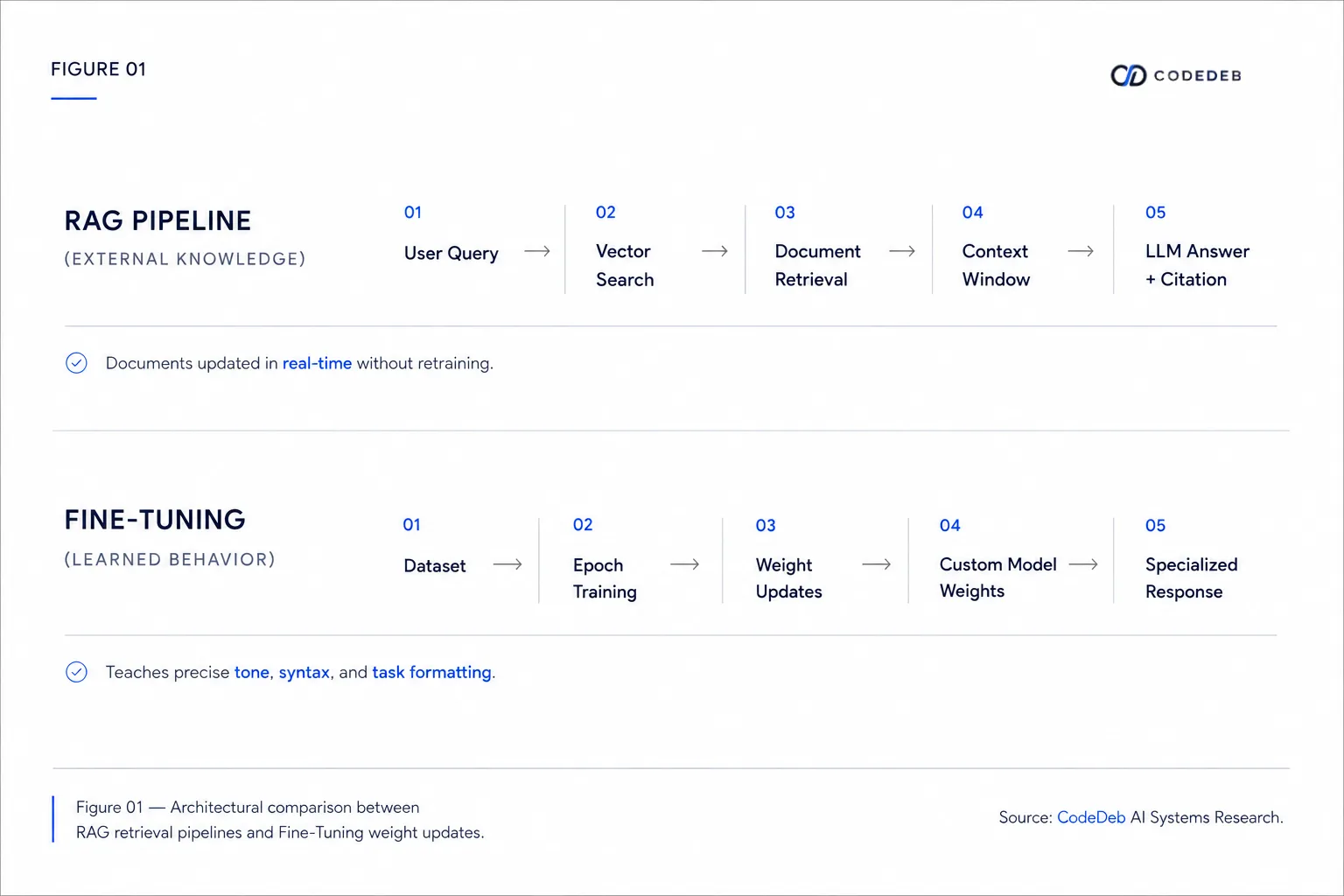
Architectural Decision Matrix
In practice, hybrid architectures often combine both: using fine-tuning to train a small model to generate consistent database queries, while using RAG to fetch real-time facts from enterprise storage.